
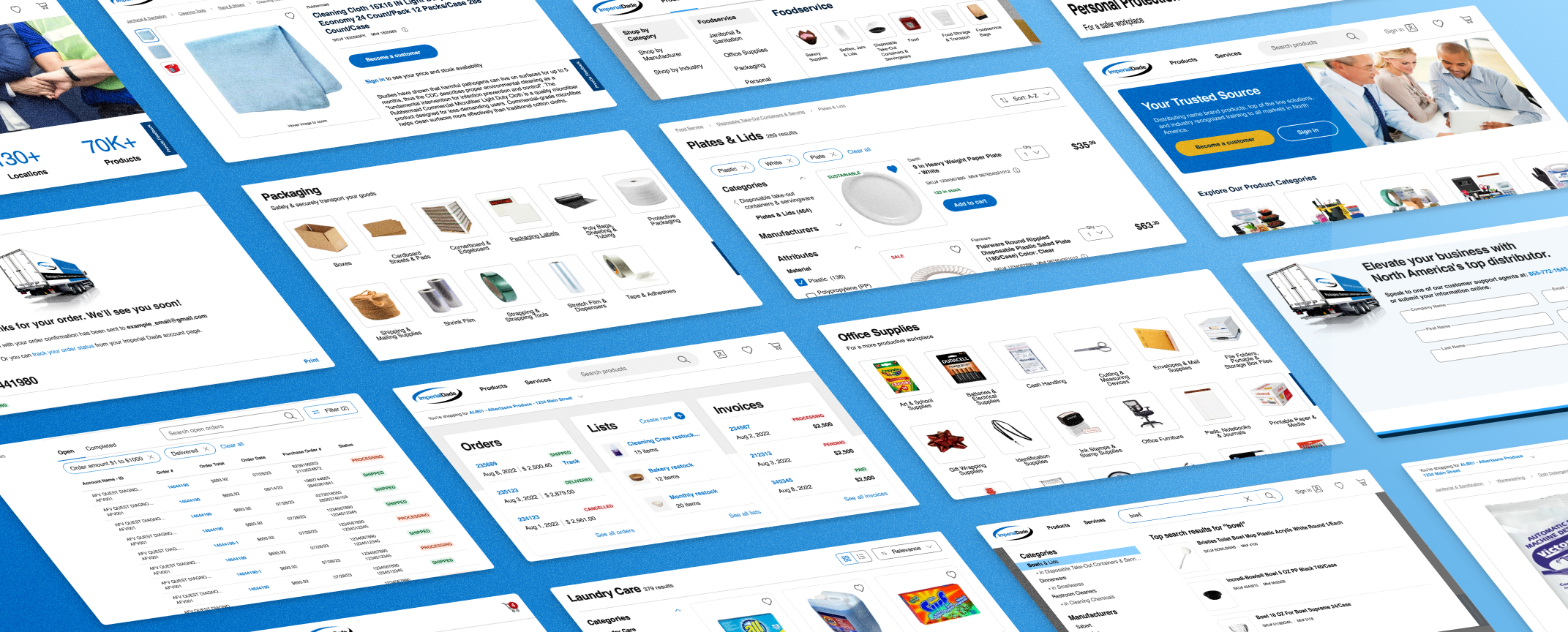
Modernization of Imperial Dade’s B2B eCommerce Platform
At a Glance

Role
UX/UI Designer

Final Product
Enterprise B2B web portal (unauthenticated + authenticated) supporting 50k+ users across desktop, tablet and mobile

Skills
Enterprise Commerce UX, Design Systems, UI Architecture

Scope
Core commerce journeys:
Search, PLP, categories, sort/filter, cart/checkout, order confirmation, account management, lists, delivery tracking

Team Structure
7 designers across 3 pods, alongside product, engineering, CX strategy, and data members

Constraints
Client digital immaturity, siloed design pods, inconsistent system ownership, MVP timeline

Duration
6 months

Tools
Figma, Mural
Context & Problem

Imperial Dade’s customer portal was an outdated eCommerce platform that no longer aligned with modern user expectations or the company’s expanding scale and ambition.
To support future growth, the experience required a complete modernization — from interface to system foundation.
Screenshots of the legacy platform, which lacked modern UX & UI patterns and clear visual hierarchy
My Role
As a UX/UI Designer embedded within 1 of 3 pods, I owned several of the platform's core commerce experiences from discovery through delivery.
End-to-End Ownership: Led the design of Search, PLP, Cart/Checkout, Order Confirmation, Lists, and Delivery Tracking
Design System Development: Built ~40% of the platform's complex, reusable components
Cross-Pod Alignment: Led design syncs to eliminate duplication and establish shared patterns
Design Consistency: Identified and resolved global UI inconsistencies across the platform
Documentation & Governance: Served as documentation lead and system historian
Process
Discovery & Validation
Conducted a heuristic evaluation to identify structural usability issues across navigation, ordering flows, and UI consistency.
Benchmarked against competitors to identify modern user expectations around reordering and account workflows.
Spearheaded rapid prototype testing to inform a baseline design direction.
System Foundations
Translated discovery insights into 4 guiding design pillars that anchored every product decision.
Contributed to the evolving design system, building complex, reusable components that standardized core commerce journeys.
Developed exploratory concepts to visualize future-state patterns.
Delivery & Optimization
Delivered high-fidelity journey flows in agile sprints across core commerce experiences.
Ensured all components were responsive across desktop, tablet, and mobile breakpoints.
Iterated on journey flows through recurring client reviews and stakeholder feedback.
Collaborated with engineering and product through QA cycles to ensure production fidelity and functional accuracy.
Final Experience
Core Commerce Experience
This redesign streamlined the end-to-end B2B ordering journey, from product discovery to checkout and confirmation. Clear hierarchy, reusable components, and responsive behaviors ensured a consistent experience across core commerce flows.
Account Management & Reordering
Beyond checkout, the authenticated experience strengthens account management through recurring purchasing, order history visibility, live delivery tracking, and customizable lists that organize supplies and enables one-click bulk add-to-cart. These tools streamline repeat ordering and support operational efficiency for B2B customers.
A Cohesive, Scalable eCommerce System
The redesigned platform reflects a system-driven approach applied consistently across desktop, tablet, and mobile. By standardizing core components and interaction patterns, we created a cohesive experience that supports product discovery, purchasing, and account management without friction. The result is a scalable foundation capable of evolving alongside future commerce needs.